

*As India’s digital economy expands, rising data security and privacy concerns are redefining regulations, reshaping tech innovation, and influencing how companies, governments, and citizens engage with technology.*
New Delhi, India — In the digital age, data is often described as the new oil. But as India’s digital economy expands at breakneck speed, the debates over who controls that oil, how it is protected, and who can access it have never been more intense.
From regulatory overhauls and policy battles to public backlash and corporate recalibration, data security and privacy concerns are fundamentally transforming India’s technology landscape — reshaping everything from how startups innovate to how global giants operate and how citizens trust digital services.
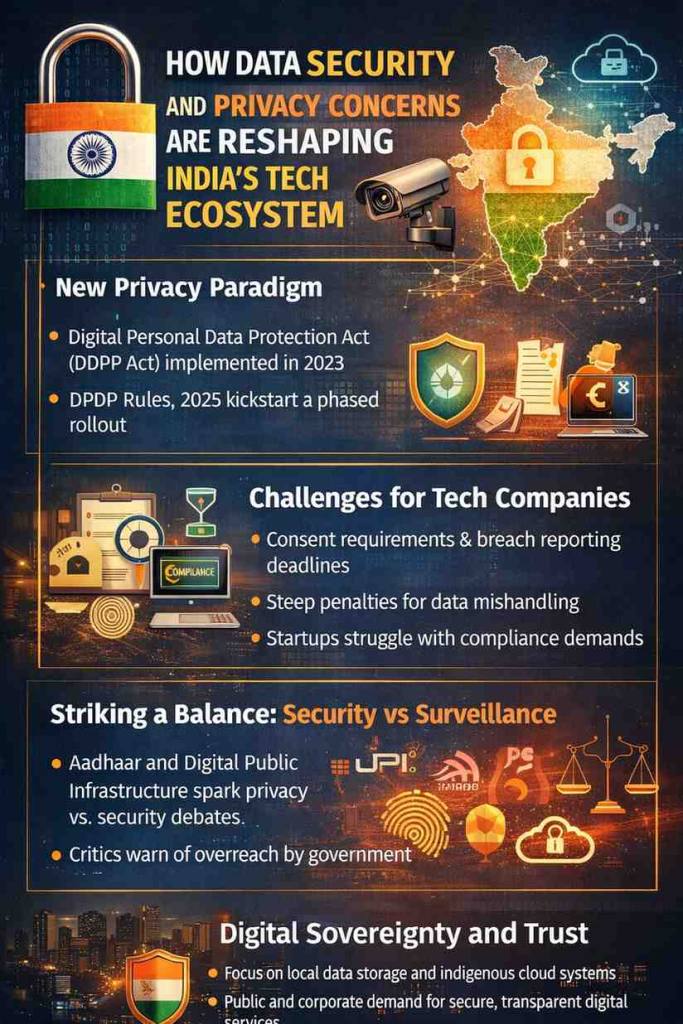
A New Privacy Paradigm Takes Shape
India’s journey toward a dedicated data protection framework has been long, winding, and at times controversial. After years of draft bills and public consultations, the government finally enacted the Digital Personal Data Protection Act, 2023 (DPDP) — India’s first comprehensive data privacy law intended to give citizens greater control over personal data and impose stringent obligations on companies processing such data.
However, the rules to operationalize the law were delayed for years, creating a regulatory gap that left Indian businesses and multinationals alike struggling to plan long-term compliance strategies. That vacuum is now rapidly closing with the government’s notification of the DPDP Rules, 2025, triggering a phased rollout of obligations around consent, breach reporting, and user rights.
The result? A seismic pivot in how technology firms — big and small — build, store, and share data.
A Compliance Crunch for Tech Companies
For startups and established tech firms alike, data privacy is no longer discretionary.
Under the DPDP regime:
Significant Data Fiduciaries — typically large enterprises with millions of users — face enhanced obligations, including annual audits and stricter governance.
Many tech firms are scrambling to adapt. According to industry sources, telecom operators and digital service providers have expressed concern that critical compliance questions remain unresolved even after the final rules were published, leading to calls for deeper consultations with the government.
For startups — particularly those without dedicated legal teams — aligning with new consent frameworks and data handling obligations is proving to be a major undertaking. Many founders report revisiting product design, rewriting privacy policies, and overhauling internal data processes to avoid steep penalties and reputational damage.
Global Giants in a Local Landscape
India’s regulatory shift is also forcing multinational technology companies to reassess their strategies.
Meta, Google, Apple, and other tech leaders have publicly flagged the need for greater regulatory clarity around emerging technologies such as AI and wearables — technologies whose data demands often fall into grey areas under existing laws. Meta has emphasized the importance of privacy-by-design principles as it pushes further into the Indian market.
Regulatory enforcement actions themselves are reshaping how these companies operate. In late 2025, India’s National Company Law Appellate Tribunal lifted a ban on WhatsApp’s inter-platform data sharing while upholding a significant fine for abusive practices related to past privacy policy updates — illustrating the complex legal push and pull around data usage and competition law.
At the same time, government attempts to mandate certain security software — such as a now-reversed order requiring preloading of a state-developed cybersecurity app on all new smartphones — sparked fierce pushback from industry and privacy advocates alike, underscoring the tension between public safety initiatives and individual privacy rights.
Data Security Beyond Law: Cyber Threats and Public Awareness
Legal frameworks are just part of the picture. India continues to face frequent cyberattacks and high-profile data breaches:
Cybersecurity experts warn that uncontrolled sharing of personal data on AI platforms can lead to leaks that end up on the dark web, exposing Aadhaar numbers, financial records, and health information.
Such warnings reflect a broader trend: as AI adoption accelerates, so too does risk. AI systems often ingest vast amounts of personal data, and without robust governance mechanisms, users — and even organisations — are exposed to vulnerabilities ranging from data poisoning to algorithmic bias.
Striking the Balance: Security vs Surveillance
India’s privacy debate is further complicated by public-sector data initiatives. National systems like Aadhaar and digital public infrastructure (DPI) platforms such as Unified Payments Interface (UPI) have revolutionized access to services, but not without igniting concerns over state surveillance and data oversight.
Critics say privacy law exemptions and the government’s broad data access powers could be repurposed for surveillance under the guise of national security — a critique amplified by some civil society groups.
These tensions highlight a core question for India’s digital future: Can a balance be struck where data fuels innovation while protecting individual freedoms?
Towards Digital Sovereignty and Trust
For many Indian policymakers, strengthening data privacy is part of a broader quest for digital sovereignty — reducing dependence on foreign cloud services and asserting local control over critical infrastructure. Think tanks propose indigenous cloud systems, sovereign data centers, and home-grown AI platforms as strategic responses to both privacy and geopolitical risk.
Meanwhile, investors and enterprises are increasingly factoring privacy compliance into business risk assessments. The Indian data center industry alone is projected to attract billions in investment, partly propelled by security and privacy considerations tied to AI growth and data governance.
Conclusion: A New Tech Ecosystem Emerges
India’s tech ecosystem is undergoing a tectonic shift. Privacy is no longer an abstract concept lurking in lengthy user agreements — it’s a core driver of business strategy, regulatory policy, and public trust.
As companies adapt, regulators refine frameworks, and citizens become more aware of what happens to their personal information, the contours of India’s digital future are being redrawn around data security and privacy.
The challenge now is not just compliance, but trust — building digital systems that are secure, transparent, and aligned with the rights of individuals while allowing innovation to flourish. In this balancing act, India could emerge not just as a global technology market, but as a standard-setter in how privacy and progress coexist in the digital era.
Also read :https://newsestate.in/how-recent-policy-decisions-could-influence-indias-economic-growth-outlook/
Add newsvent.in as a preferred source on google – click here
Last Updated on: Thursday, January 22, 2026 12:14 pm by News Vent Team | Published by: News Vent Team on Thursday, January 22, 2026 12:14 pm | News Categories: News
About The Author