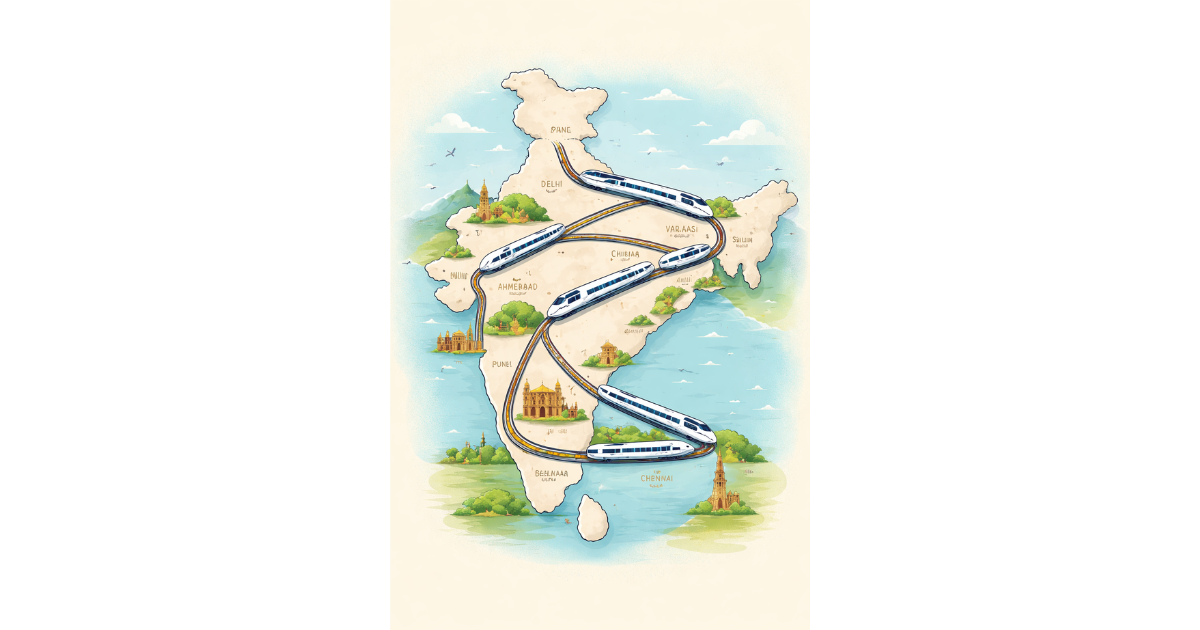
India’s proposed high-speed rail corridors aim to dramatically cut travel times and reshape intercity mobility.
In a landmark moment for the country’s transport infrastructure, the Government of India unveiled plans for seven new high-speed rail corridors in the Union Budget 2026–27, signaling a bold leap toward modern, rapid, and environmentally sustainable mobility across the nation. Presented by Finance Minister Nirmala Sitharaman, this ambitious portfolio of rail investments is designed to reimagine intercity travel, drastically compress journey times, spur regional economic development, and enhance multimodal connectivity across India’s diverse geographic and economic landscapes.
The corridors, collectively spanning around 4,000 kilometers and expected to involve an investment of roughly ₹16 lakh crore, are being positioned not just as transport projects but as “growth connectors”, envisioned to strategically link financial hubs, technology centres, manufacturing nodes, cultural capitals, and emerging urban corridors.
Connecting the Economic Heartlands: Mumbai–Pune and Beyond
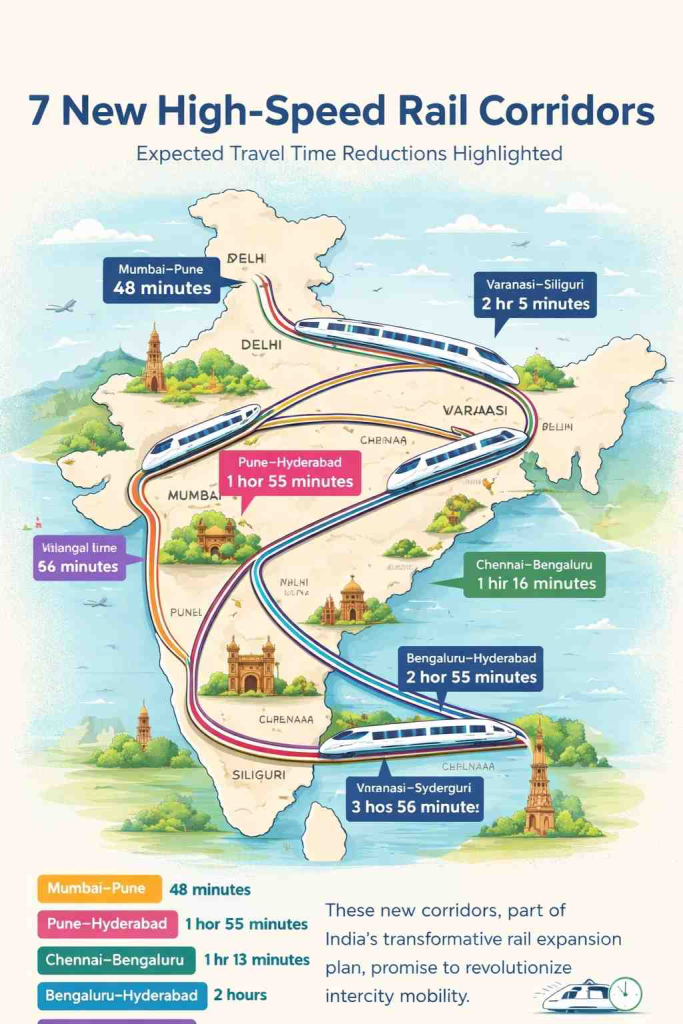
Perhaps the most transformative shift emerges in western India, where the Mumbai–Pune High-Speed Rail Corridor is projected to shrink the travel time between these two major cities to just 48 minutes. Traditionally, journeys between India’s commercial capital and its industrial satellite city have consumed hours by road and rail — a constraint that this rapid link seeks to abolish.
Linked to this is the Pune–Hyderabad High-Speed Rail Corridor, set to reduce travel time to approximately 1 hour 55 minutes, effectively knitting together two of India’s fastest-growing urban economies. As part of the extended rail strategy, the under-construction Ahmedabad–Mumbai corridor — India’s first bullet-train project — is expected to integrate with this network, expanding connectivity deep into the hinterlands of Maharashtra and beyond.
The Southern Triangle: A Growth Engine for the South
In the southern part of the country, three high-speed corridors together form what officials have termed a “South High-Speed Diamond”, a nod to the strategic triangular network joining Chennai, Bengaluru, and Hyderabad. The plan reflects a focus on enhancing connectivity across the South’s major tech, service, and manufacturing hubs — a region that has been a key engine of India’s economic expansion in recent decades.
Under this framework, the Chennai–Bengaluru corridor is expected to compress the existing travel time to approximately 1 hour and 13 minutes, while the Bengaluru–Hyderabad link is projected at roughly 2 hours. The Chennai–Hyderabad journey — previously a long and tiring affair — could be reduced to around 2 hours 55 minutes, making same-day business and leisure trips increasingly viable.
For states like Andhra Pradesh, which lies geographically between these tech megacities, the high-speed rail network promises to catalyze regional development through faster access to jobs, services, and markets, even if major stations may not be located directly within its urban footprint.
Bridging North and East: From Delhi to Siliguri
The government’s vision also incorporates two major routes in the northern and eastern corridors of the country. The Delhi–Varanasi High-Speed Rail Corridor is expected to reduce the journey between India’s capital and the cultural heartland of Varanasi to just 3 hours 50 minutes, a dramatic reduction compared with present travel times by conventional rail or road.
Extending this momentum eastward is the Varanasi–Siliguri High-Speed Rail Corridor, which will traverse significant stretches of Uttar Pradesh, Bihar, and West Bengal. Estimates suggest that this link could slash the travel time along this stretch to around 2 hours 55 minutes, opening up faster access to the northeastern gateway city of Siliguri — a key commercial and logistics hub for the region.
This corridor in particular carries transformative implications for tourism, commerce and cross-regional integration, especially in areas where long train journeys have historically posed barriers to mobility and economic exchange.
The rollout of these high-speed corridors reflects a broader strategic recalibration of India’s transport policy, centered on enhancing sustainability, efficiency, and inclusive growth. The corridors are expected to reduce carbon emissions by shifting significant passenger volumes from road and air to rail — a more energy-efficient mode of intercity transport.
Beyond environmental considerations, the corridors could reshape urbanization patterns by expanding labour markets and reducing geographic constraints on employment choices. Faster connections between cities that were once distant overnight journeys now become short commutes, encouraging greater economic integration. Analysts say the ripple effects will be felt in housing markets, industrial investments, tourism clusters, and regional service sectors.
Challenges Ahead and the Road to Realization
While the high-speed rail vision is compelling, it comes with its own set of challenges. Large-scale land acquisition, financing, civil works execution, and coordination across states with diverse regulatory environments will test the administrative capacities of both the railways and the ministries involved. Timelines for completion, detailed project reports (DPRs), and environmental clearances will be key areas to watch as these plans progress from announcement to implementation.
Despite these hurdles, India’s push to extend high-speed rail beyond the single Mumbai–Ahmedabad corridor underscores a commitment to build an integrated, future-ready transport network. If realized as planned, the seven high-speed corridors will not only transform travel but also reshape the socio-economic landscape of a nation on the move.
Add newsvent.in as a preferred source on google – click here
Last Updated on: Thursday, February 5, 2026 11:05 am by News Vent Team | Published by: News Vent Team on Thursday, February 5, 2026 11:05 am | News Categories: India, Technology
About The Author