
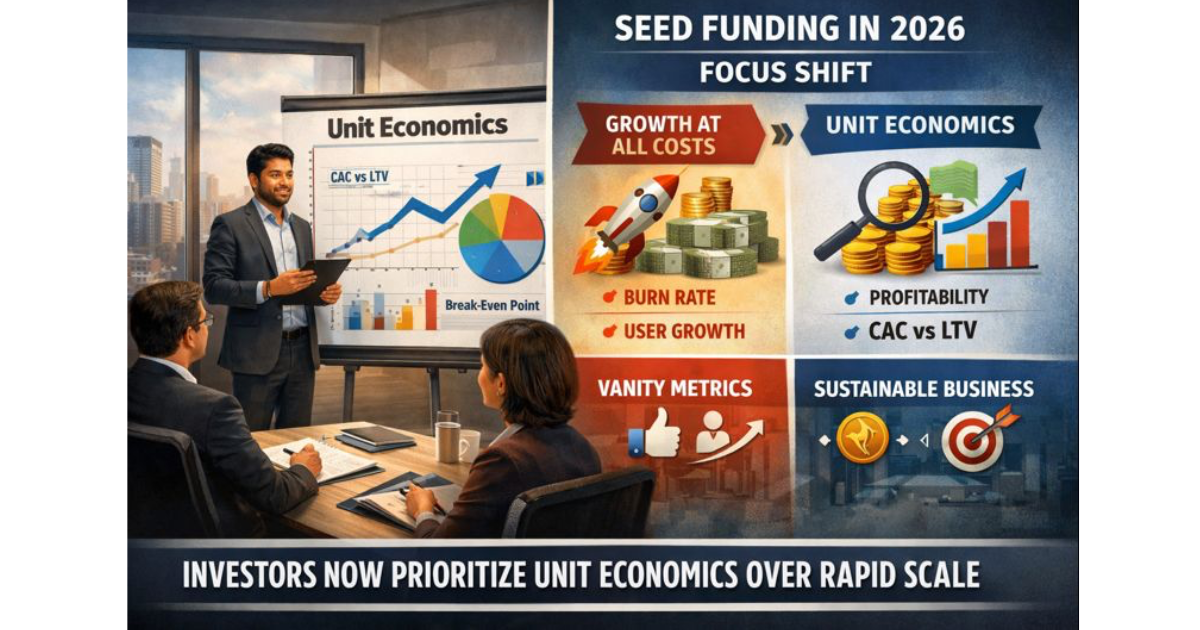
“2026 seed funding trends in India: Investors now emphasize unit economics, driving startups to focus on sustainable growth and profitability.”
As India’s startup ecosystem matures, 2026 is shaping up to be a year of recalibration for early-stage entrepreneurs seeking seed funding. The once-dominant mantra of “grow fast, raise fast” is giving way to a more cautious, data-driven approach, with investors increasingly scrutinizing unit economics rather than chasing aggressive top-line growth.
For years, startups in sectors ranging from fintech to consumer tech thrived on the promise of rapid market capture, often fueled by large funding rounds and lofty valuations. Venture capitalists were willing to overlook high burn rates if the startup demonstrated exponential user growth or market penetration. However, the economic environment of the past few years—marked by inflationary pressures, rising interest rates, and a series of high-profile startup failures—has forced a rethink.

Investors Look Beyond Vanity Metrics
“Investors are no longer seduced by vanity metrics,” says Meera Ranganathan, a partner at a prominent early-stage venture fund in Bengaluru. “They want to see that every dollar spent brings real value. The focus has shifted to how much revenue a company generates per customer relative to its acquisition cost, and whether that model is sustainable.”
Unit economics, essentially the measure of profitability at the individual customer or product level, has become the cornerstone of due diligence. Metrics such as Customer Lifetime Value (CLV), Customer Acquisition Cost (CAC), gross margins, and payback periods are being evaluated with far greater scrutiny. Startups with sound unit economics can demonstrate resilience, even in turbulent market conditions, making them more attractive to investors.
Lessons from Pandemic-Era Growth
This shift is particularly visible in sectors that saw explosive growth during the pandemic but struggled with profitability afterward. Consumer apps, hyperlocal delivery services, and niche marketplaces are under pressure to prove that their business models can survive without perpetual capital injections. Startups that once prioritized user acquisition at any cost are now required to balance growth ambitions with operational discipline.
Founders Adapt to the New Reality
For founders, the change is both a challenge and an opportunity. “It’s about building a story that is credible and defensible,” says Arjun Malhotra, founder of a SaaS startup in Hyderabad. “We can no longer impress investors by claiming we’ll capture 50% of a market in two years. They want clear evidence that each customer we acquire contributes positively to our bottom line.”
Investors, on their part, are also evolving their strategies. Many early-stage funds are now conducting deeper sector-specific analyses and mentoring startups on optimizing unit economics before writing checks. The goal is to mitigate risk and ensure that capital deployment leads to measurable growth. This approach contrasts sharply with the previous era, when funding decisions were often influenced by market hype, founder charisma, or peer pressure within venture circles.
Alternative Funding Options Support Discipline
Another factor driving this trend is the increasing availability of alternative funding sources, including angel networks, micro-VCs, and revenue-based financing. Founders now have options that allow them to remain disciplined in growth while demonstrating unit-level profitability, creating a virtuous cycle of sustainable scaling.
Growth Now Means Efficiency
For Indian startups aspiring to raise seed funding in 2026, the message is clear: growth is no longer just about speed; it’s about efficiency. Investors are looking for businesses that can demonstrate they understand their economics intimately, optimize spending, and deliver real value per customer. Those that fail to do so risk being overlooked, regardless of how large their user base or how fast they are scaling.
The emphasis on unit economics is likely to have long-term effects on the startup ecosystem. It encourages founders to focus on core operations, develop sustainable revenue streams, and build products that truly meet customer needs. While the era of hyper-aggressive scaling may be receding, the new environment offers the potential for stronger, more resilient startups that can weather economic uncertainty and thrive in the long run.
The Future of Seed Funding in India
As India continues to cement its status as a global startup hub, the ability to combine ambition with discipline may well become the defining trait of the next generation of successful startups. Seed funding in 2026 is no longer a race for attention; it is a test of business fundamentals, with unit economics serving as the ultimate benchmark.
Add newsvent.in as a preferred source on google – click here
Last Updated on: Tuesday, January 27, 2026 10:58 am by News Vent Team | Published by: News Vent Team on Tuesday, January 27, 2026 10:58 am | News Categories: News
About The Author