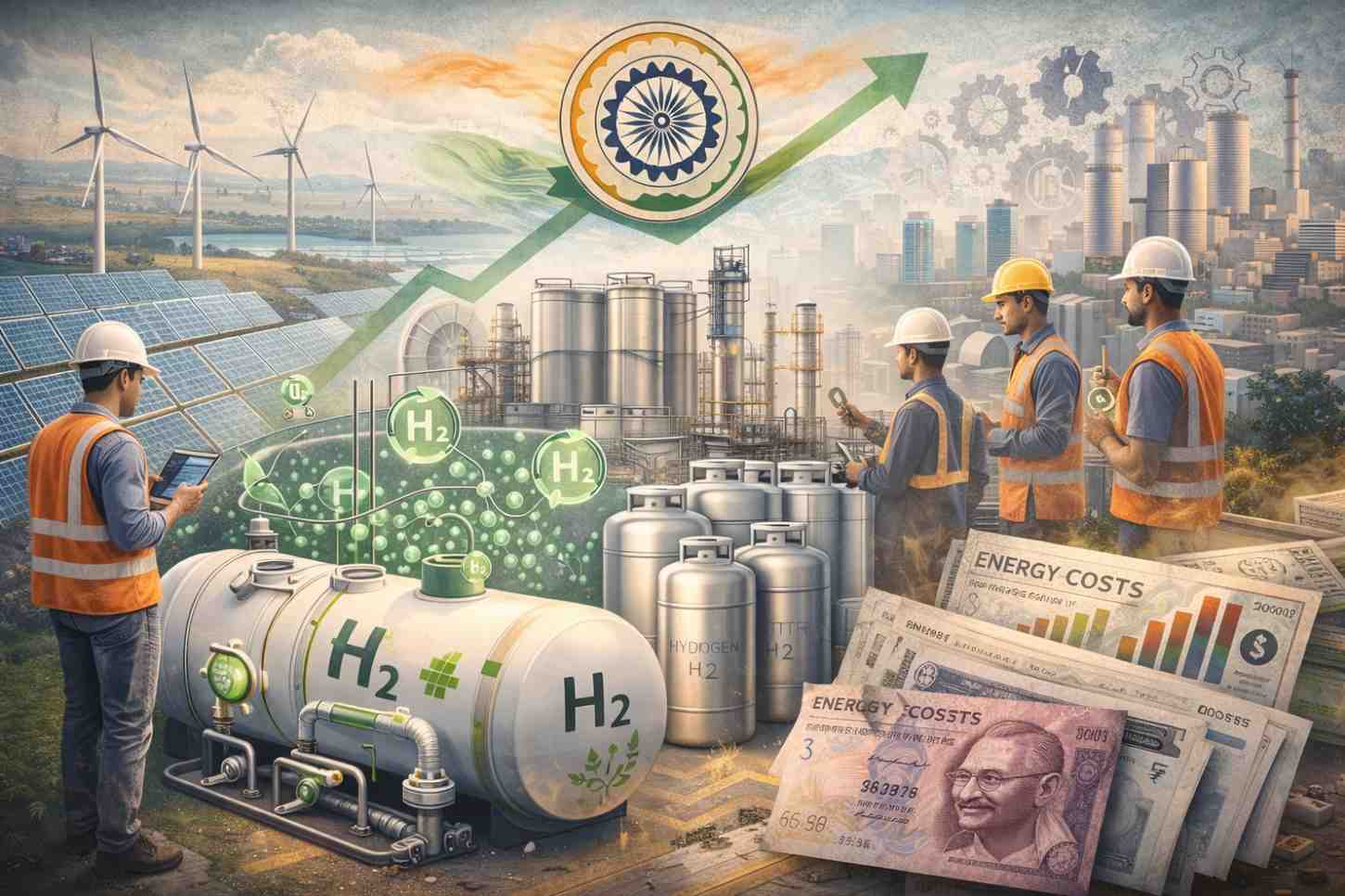
India’s push towards green hydrogen marks one of the most ambitious shifts in its energy policy since the expansion of renewable power in the early 2010s. Anchored in the National Green Hydrogen Mission, the initiative seeks to reduce dependence on fossil fuels, lower carbon emissions, and position the country as a global hub for the production, use, and export of green hydrogen. As implementation moves from policy announcements to early projects, the mission’s implications for domestic energy costs and employment in clean energy sectors are becoming clearer, though challenges around affordability, infrastructure, and workforce readiness remain significant.
Background: Why green hydrogen matters to India
India’s energy system has long been shaped by two defining pressures: rising demand driven by economic growth and a heavy reliance on imported fossil fuels. Coal continues to dominate electricity generation, while oil and gas imports account for a substantial share of the country’s energy bill. This dependence exposes India to global price volatility, supply disruptions, and long-term climate risks.
Green hydrogen, produced by splitting water using electricity generated from renewable sources such as solar and wind, has emerged globally as a potential solution for decarbonising sectors that are difficult to electrify directly. These include steelmaking, fertiliser production, refining, heavy transport, shipping, and long-duration energy storage. For India, which has set targets to achieve net-zero emissions by 2070, green hydrogen is viewed as a strategic tool rather than a standalone energy source.
The National Green Hydrogen Mission was approved by the Union Cabinet in 2023 with the aim of creating an enabling framework for large-scale adoption. It set indicative targets for domestic production capacity, renewable energy integration, and export potential, while also emphasising technology development and skill creation. Since then, policy instruments such as incentives, pilot projects, and regulatory guidelines have been rolled out to translate ambition into action.
Policy framework and institutional setup
The Green Hydrogen Mission operates under the broader climate and energy policy architecture led by the Ministry of New and Renewable Energy, in coordination with other ministries including power, steel, fertilisers, and petroleum. The mission framework outlines demand creation, supply-side support, infrastructure development, and research and development as parallel pillars.
Key policy measures include production-linked incentives for green hydrogen and green ammonia, support for electrolyser manufacturing, and provisions for renewable energy access. Public sector undertakings and private companies are encouraged to participate, with several sectors identified as early adopters due to existing hydrogen use or high emissions intensity.
The mission also aligns with India’s renewable energy targets, as green hydrogen production requires large volumes of low-cost, clean electricity. This linkage has implications for grid planning, transmission capacity, and renewable energy pricing across states.
Early developments and project announcements
Since the mission’s approval, multiple pilot and commercial-scale projects have been announced across different states. These include green hydrogen plants linked to refineries, fertiliser units, steel plants, and port-based export hubs. Several states have also released their own green hydrogen policies, offering land, transmission connectivity, and other facilitation measures to attract investment.
Electrolyser manufacturing has emerged as a critical focus area, given the need to reduce dependence on imported equipment. Indian companies have announced plans to set up electrolyser factories, while research institutions are working on improving efficiency and reducing costs. Public sector entities have initiated tenders and feasibility studies for integrating green hydrogen into existing operations.
While most projects remain at early stages, these announcements signal a gradual shift from policy intent to physical infrastructure, with timelines spanning the mid to late 2020s.
Understanding energy cost implications
One of the central questions around green hydrogen is cost. At present, green hydrogen is significantly more expensive than hydrogen produced from fossil fuels without carbon capture. The cost gap arises primarily from the price of renewable electricity, electrolyser capital costs, and financing.
In India, renewable energy tariffs have fallen sharply over the past decade, making solar and wind among the cheapest sources of new power. However, green hydrogen production requires not just low tariffs but also high availability and stable supply. Electrolysers operate most efficiently when run continuously, whereas solar and wind generation are intermittent. Addressing this mismatch can involve energy storage, grid balancing, or hybrid renewable setups, all of which add to costs.
Current estimates place the cost of green hydrogen in India higher than conventional alternatives, though costs vary by location, project scale, and financing structure. The mission’s stated objective includes reducing costs over time through scale, technology improvements, and domestic manufacturing.
Short-term impact on energy prices
In the near term, green hydrogen is unlikely to significantly lower energy costs for consumers. Instead, early adoption is concentrated in sectors where hydrogen is already used or where decarbonisation pressures are high. For example, fertiliser production relies heavily on hydrogen derived from natural gas. Replacing a portion of this with green hydrogen could raise input costs initially, potentially requiring government support to prevent price shocks.
Similarly, refineries and steel plants experimenting with green hydrogen are doing so as part of long-term transition strategies rather than immediate cost-saving measures. Any increase in production costs may be absorbed through subsidies, blending mandates, or gradual pass-through mechanisms.
For electricity consumers, the indirect impact is linked to renewable energy demand. Large green hydrogen projects could increase demand for solar and wind power, influencing capacity addition and grid investments. However, given India’s already ambitious renewable targets, this additional demand is expected to be integrated over time rather than cause abrupt price changes.
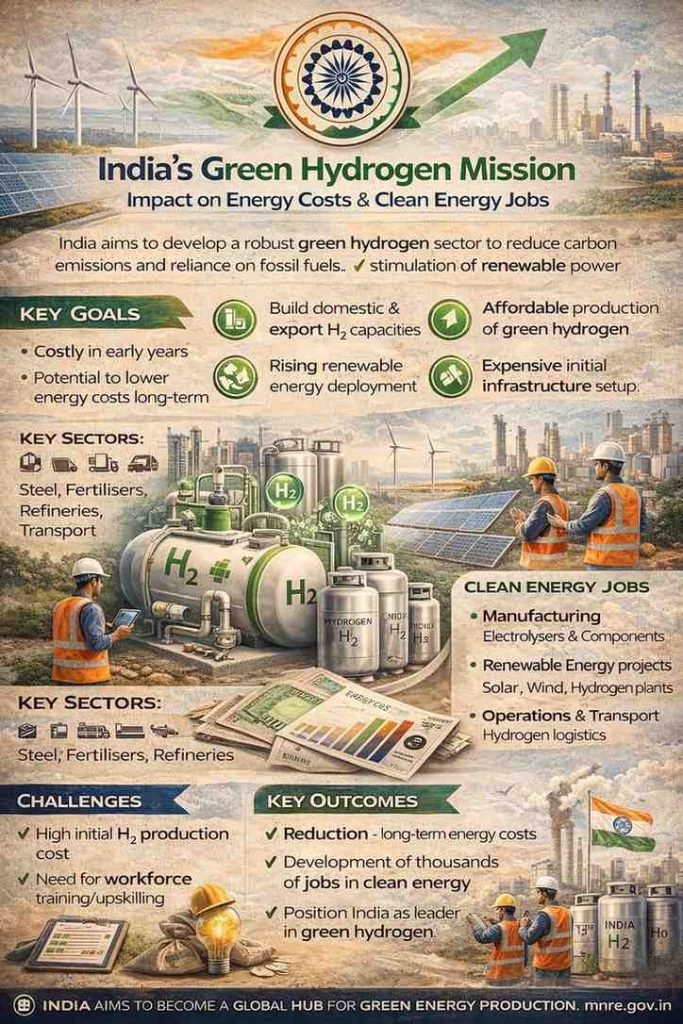
Medium- to long-term cost trajectories
The longer-term expectation under the Green Hydrogen Mission is that costs will decline as the ecosystem matures. Economies of scale in electrolyser manufacturing, improved efficiency, lower financing costs, and continued reductions in renewable energy tariffs are all factors that could narrow the cost gap.
International trends suggest that green hydrogen costs could fall substantially by the early 2030s, particularly in regions with abundant renewable resources. India’s solar and wind potential positions it favourably in this context, especially if infrastructure bottlenecks are addressed.
If cost parity with fossil-based hydrogen is achieved in certain applications, green hydrogen could contribute to stabilising energy prices by reducing exposure to imported fuel markets. However, this outcome depends on sustained policy support, technological progress, and coordination across sectors.
Infrastructure requirements and system costs
Beyond production, green hydrogen adoption requires extensive infrastructure, including storage, transportation, and end-use systems. Hydrogen has different physical properties from natural gas, requiring specialised pipelines, compression, or conversion into derivatives such as ammonia for easier handling.
Building this infrastructure entails significant capital expenditure, which can influence overall energy system costs. Decisions around whether to repurpose existing assets or build new ones will shape cost outcomes. Port infrastructure, for instance, is critical for export-oriented projects, while industrial clusters may require dedicated hydrogen networks.
These investments are long-term in nature and their cost recovery will be spread over decades. In the interim, public funding and risk-sharing mechanisms are likely to play a role in enabling projects that would otherwise be financially unviable.
Employment implications: an overview
One of the mission’s stated objectives is job creation, both direct and indirect. Green hydrogen spans multiple stages of the value chain, including renewable energy generation, electrolyser manufacturing, project development, operations, maintenance, transportation, and downstream applications.
Employment impacts are expected to be diverse, ranging from highly skilled engineering and research roles to semi-skilled technical and operational jobs. The extent and quality of job creation will depend on how much of the value chain is localised within India.
Jobs in manufacturing and supply chains
Electrolyser manufacturing represents a significant opportunity for domestic job creation. Setting up factories for producing electrolysers, power electronics, and associated components can generate employment in industrial clusters. These jobs require a mix of mechanical, electrical, and chemical engineering skills, as well as technicians and assembly-line workers.
Ancillary industries, such as suppliers of materials, sensors, and control systems, may also see growth. If India succeeds in building a competitive manufacturing base, there is potential not only to meet domestic demand but also to export equipment, further expanding employment.
Employment in renewable energy and project development
Green hydrogen projects are closely tied to renewable energy expansion. Each large hydrogen plant typically requires dedicated solar or wind capacity, driving demand for project developers, construction workers, and operations staff.
This linkage means that job creation under the Green Hydrogen Mission overlaps with employment trends in the renewable energy sector. States with strong renewable resource potential and supportive policies may see concentrated job growth, particularly in construction and maintenance.
Operations, maintenance, and technical roles
Once operational, green hydrogen facilities require ongoing management, monitoring, and maintenance. These roles include plant operators, safety specialists, instrumentation technicians, and quality control personnel. Hydrogen’s specific safety considerations necessitate specialised training, which could create demand for new certification programmes and skill standards.
Over time, as more facilities come online, a steady base of long-term operational jobs is expected, contributing to local employment stability in industrial regions.
Research, development, and innovation jobs
The mission places emphasis on research and development to improve efficiency, reduce costs, and adapt technologies to Indian conditions. This creates opportunities for scientists, researchers, and engineers in public research institutions, universities, and private R&D centres.
Areas of research include advanced electrolysers, catalysts, storage methods, and integration with power systems. While these roles represent a smaller share of total employment, they are critical for building domestic intellectual property and technological leadership.
Skill gaps and workforce readiness
Despite the potential for job creation, skill gaps remain a concern. Green hydrogen technologies are relatively new in the Indian context, and existing training systems may not fully align with industry needs. Developing a skilled workforce will require targeted education and training initiatives, including curriculum updates, vocational programmes, and industry-academia collaboration.
The success of employment outcomes will depend on how effectively these skill gaps are addressed, particularly for technicians and operators who form the backbone of large-scale projects.
Regional distribution of jobs
Employment impacts are likely to vary by region. States with strong renewable energy resources, industrial bases, and port access are positioned to attract early green hydrogen investments. This could lead to regional clusters of employment, reinforcing existing industrial corridors.
At the same time, there is potential for more balanced development if policy incentives encourage projects in less-developed regions. The extent to which the mission contributes to regional equity will depend on implementation choices at both central and state levels.
Environmental and social considerations
While green hydrogen is promoted as a clean energy solution, its broader environmental and social impacts also influence costs and employment. Large-scale renewable installations require land and water resources, raising questions about land use, community engagement, and water availability.
Addressing these issues transparently can affect project timelines and costs, as well as local acceptance. Inclusive planning and clear regulatory processes are therefore integral to the mission’s long-term viability.
Global context and competitiveness
India’s Green Hydrogen Mission is unfolding in a competitive global environment, with several countries pursuing similar strategies. International demand, particularly from regions seeking to import green hydrogen or derivatives, could shape India’s export prospects and influence domestic pricing dynamics.
Competitiveness will depend on production costs, infrastructure readiness, and regulatory clarity. If India can achieve cost-effective production at scale, exports could provide revenue streams that support domestic deployment and job creation.
Challenges and uncertainties
Despite progress, uncertainties remain. Cost reduction timelines are not guaranteed, and technological breakthroughs may take longer than anticipated. Infrastructure development faces coordination challenges across jurisdictions and agencies. Financing large projects in a nascent market involves risk, which could slow investment.
Policy consistency is another factor. Long-term investor confidence depends on stable and predictable regulations, incentives, and market signals. Any abrupt changes could affect project economics and employment outcomes.
Conclusion
India’s Green Hydrogen Mission represents a structural shift in the country’s energy transition strategy, with implications that extend beyond emissions reduction. In the short term, the mission is unlikely to lower energy costs and may involve higher expenses in certain sectors as new technologies are adopted. Over the medium to long term, however, successful scaling and cost reductions could enhance energy security and moderate exposure to global fuel markets.
From an employment perspective, the mission has the potential to generate a wide range of jobs across manufacturing, renewable energy, operations, and research. Realising this potential will require sustained policy support, investment in skills, and careful integration with existing energy systems.
As India moves through the implementation phase, the Green Hydrogen Mission will be judged not only by production targets but also by its ability to deliver affordable energy, meaningful employment, and a credible pathway towards a lower-carbon economy.
Also read – https://newsvent.in/wp-admin/post.php?post=4401&action=edit
Add newsvent.in as preferred source on google – click here
Last Updated on: Thursday, January 29, 2026 11:45 am by News Vent Team | Published by: News Vent Team on Thursday, January 29, 2026 11:45 am | News Categories: India
About The Author