
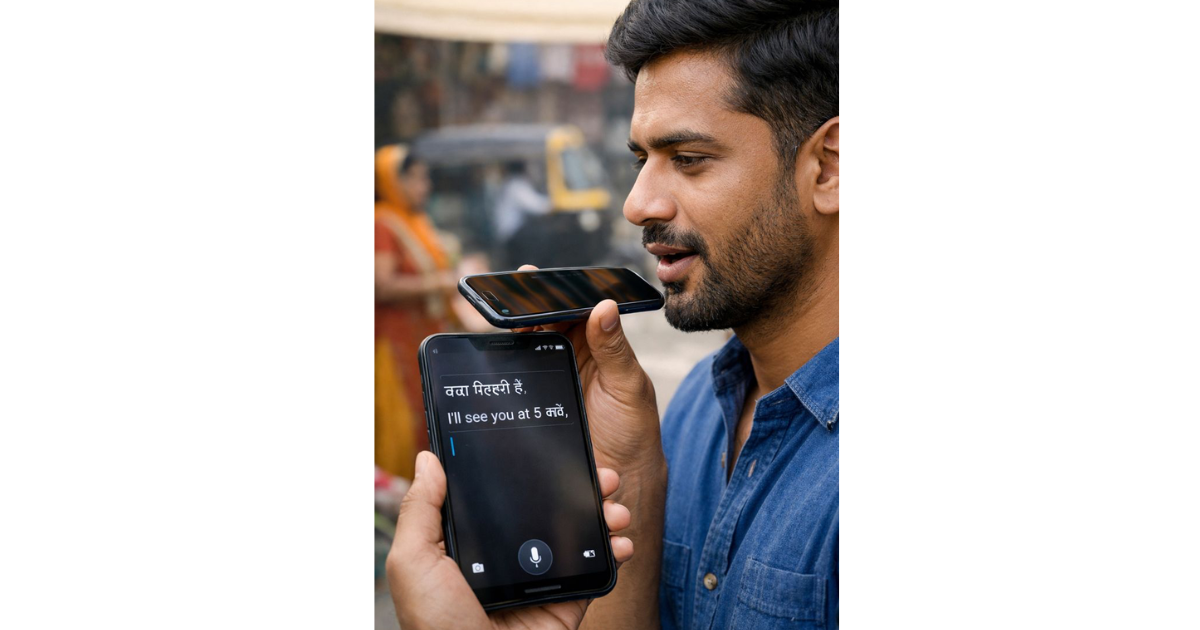
On-device AI in 2026 is transforming smartphones into powerful local language voice typing tools for millions of Indian users.
In 2026, one of the most transformative shifts in India’s digital story is unfolding not in flashy app launches or futuristic gadgets, but in a deeply personal space: how people speak to their smartphones. Across cities, small towns, and villages, millions of Indians are now dictating messages, filling government forms, searching the web, and even drafting business documents using voice typing in their own languages. What makes this moment significant is not just better speech recognition, but the rise of powerful on-device artificial intelligence that works without depending on constant internet connectivity.
This change is redefining smartphone usage in India, turning devices into true linguistic companions rather than English-first tools adapted awkwardly for Indian users.
From Cloud Dependence to On-Device Intelligence
For years, voice typing relied heavily on cloud-based servers. Spoken words were sent to distant data centres, processed, and returned as text. While this worked reasonably well in metro areas with strong connectivity, it often failed users in low-network zones, introduced delays, and raised privacy concerns. More importantly, it struggled with India’s linguistic complexity, accents, code-mixed speech, and regional expressions.
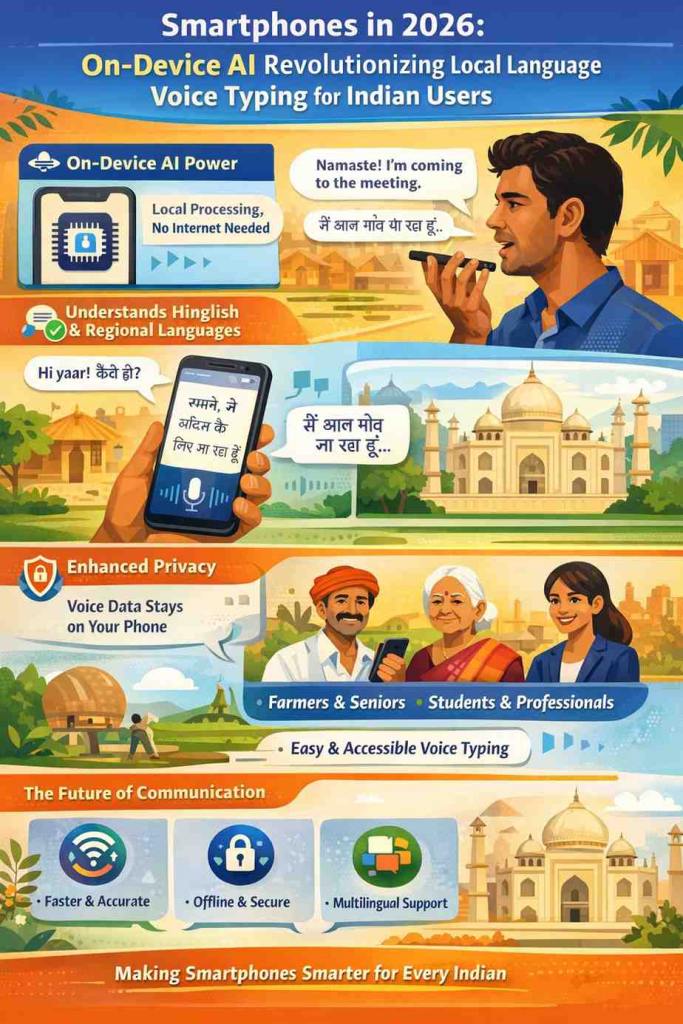
By 2026, smartphone makers and chip designers have shifted the intelligence directly onto the device. Advanced neural processing units embedded in mid-range and premium smartphones now handle speech recognition locally. This allows real-time transcription, even in airplane mode, with dramatically improved accuracy for Indian languages such as Hindi, Tamil, Telugu, Bengali, Marathi, Kannada, Malayalam, Gujarati, Punjabi, and Odia.
The result is faster responses, fewer errors, and a system that adapts to how Indians actually speak, not how algorithms expect them to.
Understanding India’s Languages the Indian Way
One of the biggest breakthroughs of on-device AI is contextual understanding. Indian users rarely speak in a single, pure language. Conversations naturally blend English with regional languages, often within the same sentence. Earlier voice typing systems struggled with this fluidity, producing garbled or incomplete text.
In 2026, AI models trained specifically on Indian speech patterns can seamlessly interpret Hinglish, Tanglish, or Telugu-English mixes without forcing users to switch keyboards or language settings. A shopkeeper dictating a WhatsApp message, a student taking notes, or a gig worker filling a delivery form can speak naturally and see accurate text appear instantly.
Crucially, these models also understand local names, place references, and culturally specific phrases, reducing the frustration that once made voice typing feel unreliable.
Privacy Becomes a Feature, Not a Footnote
As awareness around data privacy grows in India, on-device AI has emerged as a trust-building feature. Since voice data no longer needs to be transmitted to external servers, sensitive conversations remain within the phone. This is especially important for professionals, journalists, healthcare workers, and small business owners who rely on voice input for daily tasks.
Smartphone brands are now actively marketing on-device processing as a privacy advantage, highlighting that users’ voices are processed, learned from, and discarded locally unless they explicitly opt in to cloud sync. In a country where digital trust is essential for mass adoption, this shift is proving decisive.
Empowering the Next Billion Smartphone Users
Perhaps the most profound impact of local language voice typing is its role in digital inclusion. For first-time smartphone users, typing on small screens has always been a barrier, particularly for those unfamiliar with English keyboards or formal written language.
Voice-first interaction lowers this barrier dramatically. Farmers can dictate crop-related queries, senior citizens can send messages without struggling with text, and small traders can manage digital payments and records using speech alone. On-device AI ensures this experience remains smooth even in areas with patchy internet, making smartphones genuinely useful rather than intimidating.
In many ways, voice typing in regional languages is becoming the primary interface for India’s next wave of internet users.
Productivity and Creativity on the Go
Beyond basic communication, improved voice typing is reshaping productivity. Journalists dictate rough drafts while commuting, entrepreneurs record ideas in their native language, and students convert spoken explanations into neatly formatted notes. On-device AI can now automatically add punctuation, understand tone, and even format paragraphs appropriately, making dictated text feel polished rather than raw.
Some smartphones in 2026 also support multilingual dictation within a single document, allowing users to switch languages mid-sentence without interruption. This reflects the reality of modern Indian communication, where multilingual fluency is the norm, not the exception.
The Competitive Race Among Smartphone Makers
The rise of on-device AI has intensified competition among smartphone brands in India. Hardware choices, such as dedicated AI cores and efficient chip architectures, now matter as much as camera quality or battery life.
Add newsvent.in as a preferred source on google – click here
Last Updated on: Friday, January 30, 2026 12:31 pm by News Vent Team | Published by: News Vent Team on Friday, January 30, 2026 12:31 pm | News Categories: News
About The Author