India’s SaaS ecosystem is entering a new phase of artificial intelligence adoption, moving beyond simple conversational tools toward systems that can act, decide, and execute with minimal human intervention. Known as agentic AI, this emerging approach is redefining how software products are built and how value is delivered to enterprises. For Indian SaaS founders competing in global markets, the shift from chatbots to autonomous workflows reflects changing customer expectations, advances in AI capabilities, and a growing focus on measurable business outcomes.
From Conversational AI to Agentic Systems
For several years, chatbots were the most visible application of AI in enterprise software. They helped automate customer support, answer queries, and handle basic workflows. While these tools improved efficiency, they largely remained reactive, responding to user prompts rather than taking initiative.
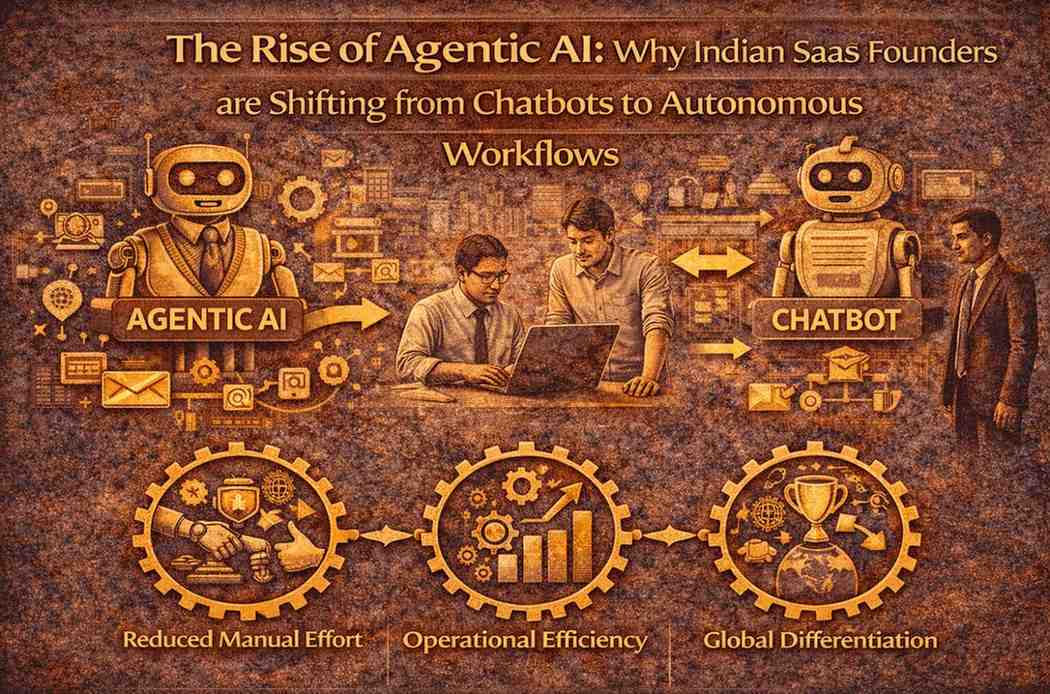
Agentic AI represents a fundamental shift. Instead of waiting for instructions, these systems are designed to pursue goals, plan steps, interact with multiple tools, and adapt based on outcomes. This evolution moves AI from being an assistant to becoming an active participant in business processes, capable of handling complex, multi-step tasks across systems.
Why Indian SaaS Founders Are Embracing Agentic AI
Indian SaaS founders operate in an intensely competitive global environment, often serving international customers with high expectations around automation, scalability, and cost efficiency. As AI capabilities mature, customers are demanding solutions that do more than respond to queries. They want software that can autonomously manage workflows, reduce manual intervention, and deliver consistent results.
Agentic AI offers a way to differentiate products in crowded markets. By embedding autonomy into core workflows, SaaS companies can provide deeper value, positioning their products as operational platforms rather than standalone tools.
Limitations of Traditional Chatbot-Centric Models
Chatbots, despite their widespread adoption, have clear limitations. They rely heavily on user input, struggle with context beyond predefined flows, and often require human escalation for complex tasks. For enterprise users, this can result in fragmented workflows and limited efficiency gains.
Indian founders have recognised that while chatbots improve surface-level interactions, they rarely transform underlying processes. Agentic AI addresses this gap by integrating reasoning, memory, and action, allowing systems to complete tasks end-to-end rather than acting as intermediaries.

What Makes Agentic AI Different
Agentic AI systems are built around the concept of goals rather than prompts. They can break down objectives into smaller tasks, decide which tools or data sources to use, and adjust strategies based on feedback. This enables software to operate more like a digital worker than a conversational interface.
For example, instead of merely answering questions about a sales pipeline, an agentic system can analyse data, identify stalled deals, send follow-ups, update records, and alert managers—all without direct human input. This level of autonomy marks a significant leap in how AI is applied within SaaS products.
Impact on Enterprise Workflows
The shift toward agentic AI is closely tied to enterprise demand for automation at scale. Businesses are under pressure to streamline operations, reduce costs, and improve speed of execution. Autonomous workflows powered by agentic AI can handle repetitive, rules-based, and even semi-judgment-based tasks across departments.
Indian SaaS products serving functions such as customer support, finance, HR, and supply chain management are increasingly embedding agentic capabilities to automate processes that previously required constant human oversight. This not only improves efficiency but also enhances consistency and compliance.
Competitive Advantage for Indian SaaS Companies
India’s SaaS sector has traditionally competed on engineering talent, cost efficiency, and speed of execution. Agentic AI adds a new dimension to this advantage. Founders who successfully integrate autonomous systems can offer global customers advanced capabilities at competitive price points.
This shift also aligns with India’s strength in building scalable backend systems. Agentic AI relies heavily on orchestration, integration, and infrastructure—areas where Indian engineering teams excel. As a result, many founders see agentic AI as a natural evolution rather than a disruptive leap.
Challenges in Building Agentic AI Systems
Despite its promise, agentic AI introduces new challenges. Autonomous systems raise concerns around control, reliability, and accountability. Enterprises need assurance that AI-driven actions align with business rules, regulatory requirements, and ethical standards.
Indian founders must invest in robust governance frameworks, transparent decision-making logs, and fail-safe mechanisms. Building trust is essential, particularly when AI systems are given the authority to act without human approval.
Changing Expectations from Customers and Investors
The rise of agentic AI is also reshaping how customers and investors evaluate SaaS companies. Customers increasingly ask not just what a product can do, but how much manual effort it can eliminate. Investors, meanwhile, look for companies that can demonstrate tangible productivity gains and strong differentiation through technology.
Agentic AI helps address both expectations by tying AI capabilities directly to operational outcomes. This alignment strengthens business cases and supports sustainable growth, especially in a funding environment that rewards efficiency and clear value creation.
Ethical and Workforce Considerations
As AI systems become more autonomous, concerns around workforce impact and ethical use become more prominent. Agentic AI can replace or significantly augment certain roles, raising questions about job displacement and skill transitions.
Responsible SaaS founders are beginning to address these issues proactively, positioning agentic AI as a tool for augmentation rather than replacement. Clear communication, reskilling initiatives, and thoughtful deployment are essential to ensure that autonomy enhances human work rather than undermining it.
The Road Ahead for Agentic AI in Indian SaaS
The shift from chatbots to autonomous workflows signals a broader transformation in how AI is used within enterprise software. For Indian SaaS founders, agentic AI represents both an opportunity and a responsibility. It offers a chance to lead globally in next-generation AI applications, while also demanding higher standards of reliability, transparency, and governance.
The rise of agentic AI is not about abandoning conversational interfaces but about embedding intelligence deeper into workflows. As Indian SaaS companies continue to innovate, those that successfully harness autonomy while maintaining trust are likely to shape the future of enterprise software in the years ahead.
Add newsvent.in as preferred source in google – click here
Last Updated on: Tuesday, January 27, 2026 10:45 am by News Vent Team | Published by: News Vent Team on Tuesday, January 27, 2026 10:45 am | News Categories: India
About The Author