
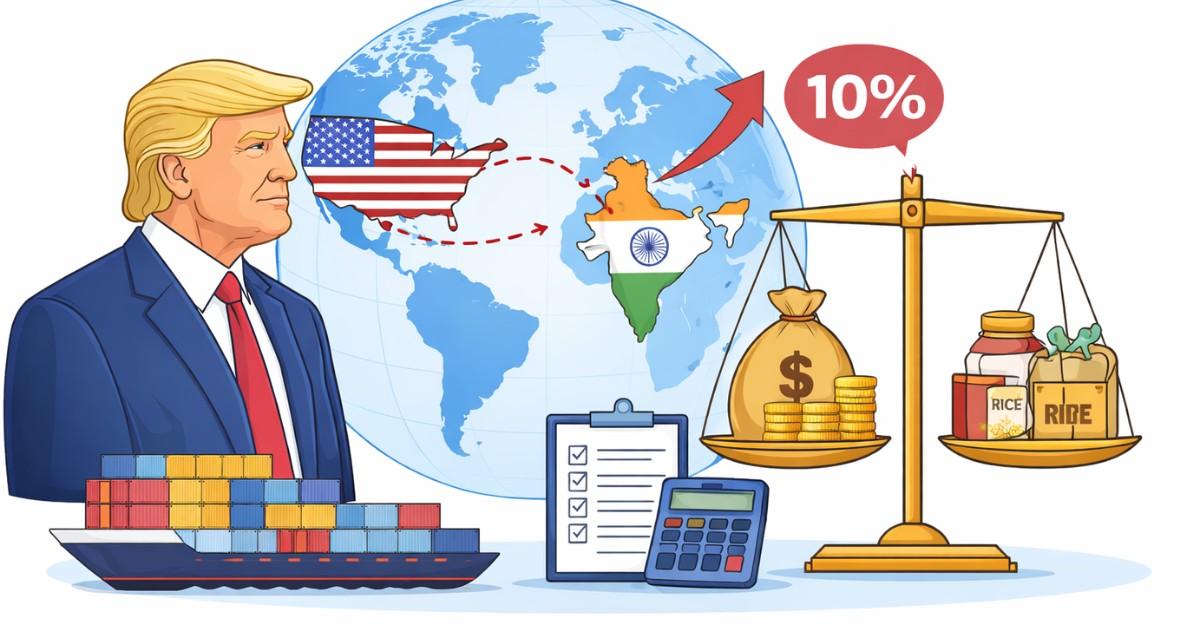
Trump’s 10% Global Tariff India Impact has become a key focus for policymakers after US President Donald Trump signed a new executive order introducing a 10% tariff on a broad range of imports. The decision follows a US Supreme Court ruling that struck down significant portions of his earlier trade duties, prompting the administration to issue a revised framework. The White House confirmed that the new tariff will take effect on February 24.
The Trump 10% global tariff order has added fresh uncertainty to global trade flows. In India, officials are reviewing the potential economic impact, especially concerning nearly $175 billion in previously collected duties that were under legal challenge in US courts. Authorities are examining whether the new tariff structure could affect pending refund claims and influence India-US trade relations in the coming months.
Supreme Court Ruling and New Executive Order
The US Supreme Court recently ruled against key elements of earlier trade duties introduced under emergency economic powers. The court found that aspects of the tariff framework exceeded statutory limits. The judgment effectively invalidated certain levies imposed on imports from multiple countries.
Within days of the ruling, President Trump announced a new executive order introducing a uniform 10% tariff on global imports. Administration officials stated that the revised order is designed to comply with legal standards while advancing domestic manufacturing goals and protecting US economic interests.
The executive order, as outlined by the White House, frames the tariff as a measure to address trade imbalances and strengthen domestic industry. It remains unclear how the new structure differs legally from the duties previously invalidated by the court.
India’s Trade Exposure
India is among the countries monitoring the situation closely. Bilateral trade between India and the United States has expanded significantly in recent years, spanning sectors such as pharmaceuticals, information technology services, textiles, engineering goods, and electronics.
While India was not the sole focus of earlier US tariffs, Indian exporters were affected in select categories. Trade policy experts note that any broad-based global tariff could increase costs for Indian manufacturers exporting to the US market.
Officials in New Delhi are assessing whether the fresh 10% tariff will apply across all categories or whether exemptions may be introduced. The Ministry of Commerce and Industry has not issued a detailed public response but is understood to be evaluating legal and diplomatic options.
Uncertainty Over Duty Refunds
A key issue under review is the status of approximately $175 billion in duties that were collected under the previous tariff framework and later challenged in court. With the Supreme Court striking down elements of those measures, affected importers had expected clarity on refunds.
However, the introduction of a new executive order has raised questions about whether pending refund claims could face delays or legal complications. Trade lawyers in Washington have indicated that refund eligibility may depend on how the administration restructures its tariff authority and whether the new order is applied retroactively.
Indian exporters and industry bodies are watching the situation carefully. Any prolonged legal dispute over refunds could affect global supply chains and financial settlements tied to earlier shipments.
Broader Global Reaction
The announcement has also drawn attention from other major trading partners. Several governments are reviewing the order’s compliance with World Trade Organization (WTO) rules. Analysts say that a universal tariff structure may invite fresh challenges at multilateral trade forums if it is seen as discriminatory or inconsistent with existing commitments.
Financial markets have responded cautiously. Investors are tracking potential ripple effects on global trade flows, inflation, and supply chain costs.
India’s Strategic Approach
India and the United States have strengthened economic ties in recent years, with both sides seeking to deepen cooperation in critical sectors including technology and clean energy. Any new trade friction may be addressed through established bilateral mechanisms.
Policy experts suggest that India may pursue dialogue through trade consultations while assessing the impact on exporters. Officials are also likely to examine whether domestic policy measures are needed to cushion affected industries.
At present, the full legal and economic implications of the new US tariff order remain uncertain. As February 24 approaches, businesses and governments worldwide are awaiting detailed implementation guidelines from Washington.
For India, the priority remains safeguarding trade interests while maintaining stability in one of its most important economic partnerships.
Also read: UPI Surpasses Cash in India: Digital Payments Now Lead with 57% of Transactions
Add News Vent as a preferred source on Google – Click Here
Last Updated on: Saturday, February 21, 2026 11:29 am by News Vent Team | Published by: News Vent Team on Saturday, February 21, 2026 11:29 am | News Categories: Politics
About The Author