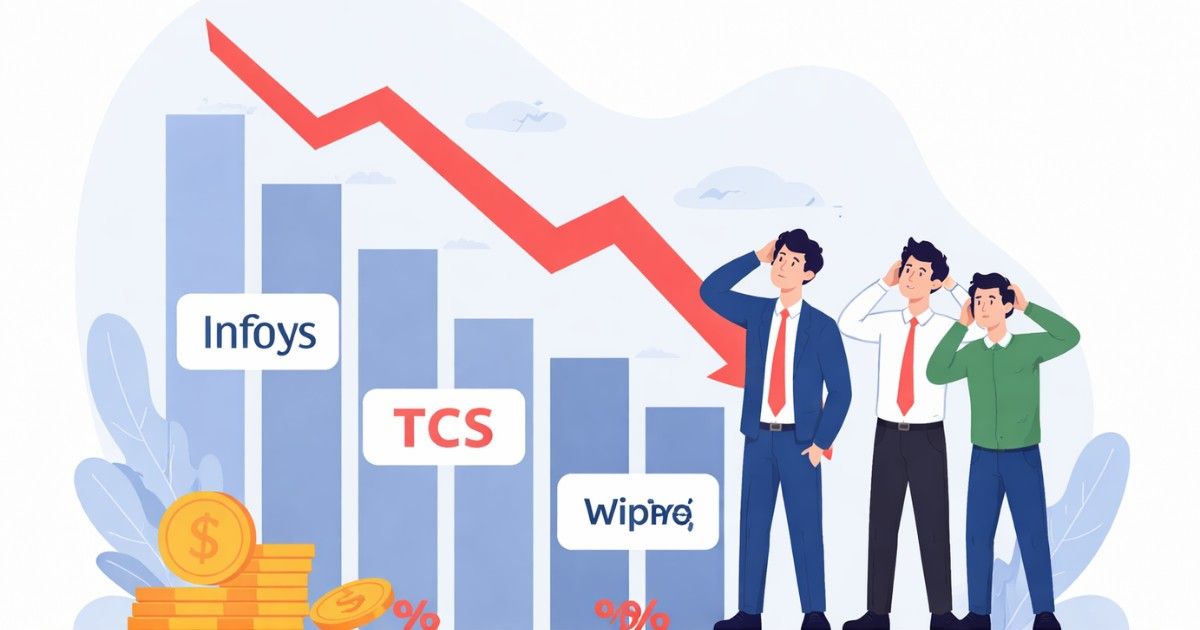
IBM Slump Impact on Indian IT Stocks became a key market theme on Dalal Street after shares of US technology major IBM fell sharply overnight. The nearly 13% decline in IBM’s stock has raised concerns about global enterprise technology spending, leading investors to closely track movements in export-focused companies such as Infosys, TCS and Wipro.
With a significant portion of revenue for Indian IT firms coming from the United States, any sharp move in a global technology bellwether tends to influence sentiment in domestic markets. Investors are now assessing whether the recent decline reflects company-specific factors or signals a broader slowdown in global tech demand.
IBM Slump Impact on Indian IT Stocks: Why IBM’s Fall Matters to Dalal Street
The IBM Slump Impact on Indian IT Stocks has drawn attention because IBM is widely regarded as a bellwether for enterprise technology demand. The company operates across consulting, hybrid cloud, and infrastructure services, segments that closely overlap with revenue streams of Indian IT exporters.
When a global technology leader reports weaker-than-expected performance or cautious forward guidance, investors often reassess sector-wide growth expectations. Market participants say the recent decline has raised questions about whether global clients are tightening discretionary technology budgets.
Although the immediate trigger was linked to earnings-related commentary reported by international financial media, the reaction has extended beyond US markets. For Dalal Street, the development has revived discussions around external risk factors influencing domestic IT valuations.
How the IBM Slump Impact on Indian IT Stocks Reflects Global Tech Spending Trends
The IBM Slump Impact on Indian IT Stocks is largely sentiment-driven, but it reflects deeper concerns about global enterprise spending cycles. Indian IT majors such as Infosys, TCS and Wipro derive a significant share of revenue from North America.
Any indication that US corporations may delay digital transformation projects, renegotiate contracts, or reduce consulting spends can affect growth projections. Analysts note that while Indian companies maintain diversified client bases and long-term contracts, investor sentiment often reacts quickly to global signals.
In early trade, Indian IT stocks reflected caution rather than panic. Brokerage commentary suggests that the current volatility appears linked more to risk perception than to immediate deterioration in order books.
Investor Strategy After the IBM Slump Impact on Indian IT Stocks
Following the IBM Slump Impact on Indian IT Stocks, investors are closely monitoring upcoming earnings releases from global technology firms for clarity on demand visibility. Market experts indicate that management guidance on deal pipelines and client spending will play a crucial role in shaping near-term stock performance.
Currency trends and macroeconomic indicators are also being tracked, as they influence export margins for Indian IT companies. While short-term corrections are common in globally linked sectors, long-term performance typically depends on sustained digital adoption, operational efficiency, and stable client demand.
For now, the episode highlights how closely Indian technology counters remain connected to global market movements, reinforcing the sensitivity of Dalal Street to developments on Wall Street.
What Investors Are Watching Next
Investors are now closely tracking commentary from global technology firms during the ongoing earnings season. Any confirmation of a slowdown in enterprise spending could weigh on valuations across the IT sector. Conversely, reassuring guidance may help stabilise sentiment.
Currency movements will also be under scrutiny. A stable or weakening rupee against the US dollar can partially offset margin pressures for Indian IT exporters.
For now, the sharp move in IBM has acted as a reminder of how closely Indian technology stocks are tied to global trends. As Dalal Street reacts to signals from Wall Street, investors are balancing short-term volatility with long-term structural demand for digital services.
While the immediate correction reflects caution, analysts emphasise that broader conclusions will depend on sustained trends in global technology spending rather than a single trading session’s reaction.
Also read: Trump’s 10% Global Tariff: How India Could Be Impacted After Supreme Court Ruling
Add News Vent as a preferred source on Google – Click Here
Last Updated on: Tuesday, February 24, 2026 2:47 pm by News Vent Team | Published by: News Vent Team on Tuesday, February 24, 2026 2:47 pm | News Categories: Business
About The Author