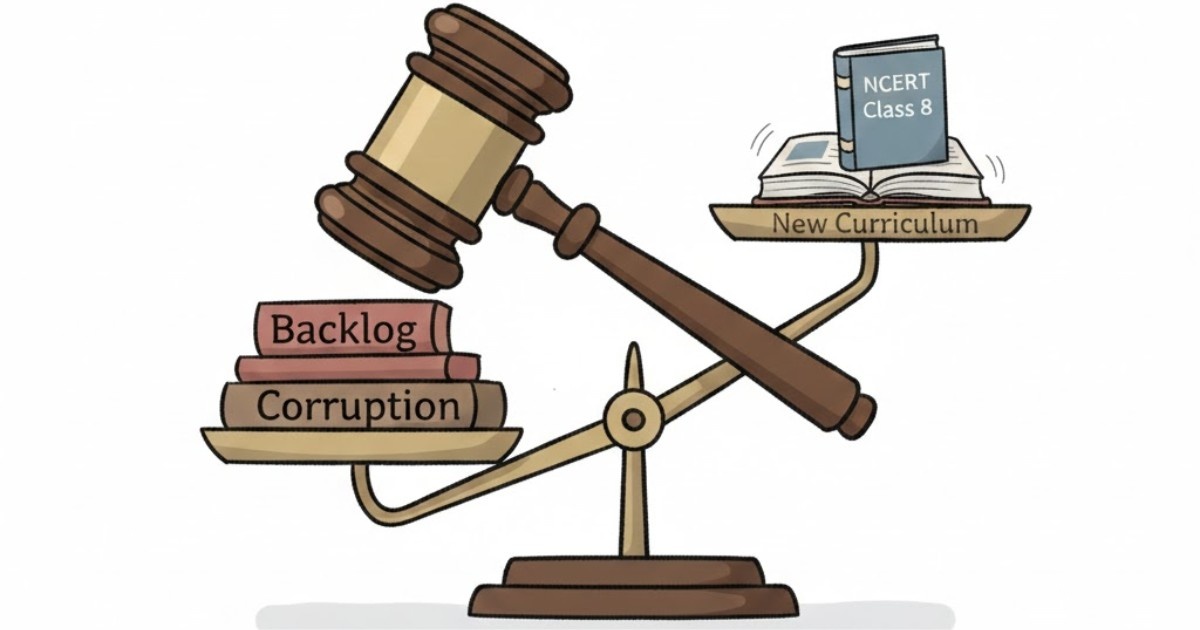
The NCERT Class 8 Judiciary Chapter in the latest textbook revision has sparked discussion among educators and parents after explicitly outlining challenges within India’s justice system, including case backlogs and accountability concerns. The updated content introduced by the National Council of Educational Research and Training places verified judiciary backlog statistics and structural issues at the centre of classroom learning.
By referencing the large number of pending cases in district courts and acknowledging debates around transparency in the judicial system, the revised chapter reflects a more issue-based approach to civics education. The move has led to increased public interest in the new textbook and its treatment of institutional realities.
NCERT Class 8 Judiciary Chapter: Backlog Statistics in Focus
The NCERT Class 8 Judiciary Chapter draws attention to the large number of pending cases in district courts across India. According to data periodically released by judicial and government sources, total pending cases across courts run into several crores, with district courts accounting for the majority share.
By presenting verified backlog figures within a school textbook, the NCERT Class 8 Judiciary Chapter introduces students to practical governance challenges linked to the justice delivery system. The chapter explains how prolonged delays can affect access to justice and outlines structural factors such as judicial vacancies, procedural complexity and increasing litigation.
Education experts note that incorporating official data into classroom material can help students understand institutions in a realistic manner rather than only through constitutional definitions. At the same time, they emphasise that contextual explanation remains important to ensure that young learners interpret judiciary backlog statistics accurately and responsibly.
Addressing Corruption and Accountability
The chapter has also drawn attention for mentioning concerns about corruption within the judicial system as part of a broader discussion on institutional challenges. It reportedly frames the issue within the larger context of transparency, ethical conduct and mechanisms for oversight.
Legal scholars note that discussions on judicial accountability have long been part of public discourse, including debates over judicial appointments, disciplinary processes and reforms. By incorporating these themes into a middle school curriculum, the textbook reflects an effort to present institutions in a balanced manner, highlighting both strengths and areas requiring reform.
Officials have not indicated that the content departs from established academic frameworks. Instead, it appears aligned with broader curricular goals aimed at fostering civic awareness.
Educational Approach and Curriculum Reform
NCERT has, in recent years, undertaken revisions to align textbooks with updated national education priorities. The judiciary chapter is part of the broader social science curriculum designed to introduce students to democratic institutions, constitutional values and governance processes.
According to educators familiar with curriculum development, the approach appears to encourage critical thinking while maintaining respect for constitutional structures. The chapter reportedly explains the hierarchy of courts, the role of judges and the rights of citizens alongside discussion of challenges.
Teachers contacted by this publication indicated that the success of such content will depend on classroom delivery. They stressed that complex topics must be explained carefully to avoid misunderstanding while promoting informed discussion.
Wider Public Response
The inclusion of backlog statistics and references to institutional challenges has sparked debate on social media and parent forums. Some observers view it as a candid attempt to familiarise students with ground realities. Others have called for clarity on how sensitive issues are framed for young learners.
There has been no official statement suggesting changes to the content following the discussion. Education authorities have historically maintained that textbooks aim to reflect constitutional principles and factual information.
A Shift Toward Institutional Awareness
The updated chapter signals a curriculum that seeks to present governance in practical terms. By discussing both the functioning and the pressures faced by courts, the NCERT Class 8 new book appears to adopt a more data-driven and issue-based approach.
As discussions continue, the focus remains on how schools will interpret and teach the revised material. The development underscores the evolving role of textbooks in shaping civic understanding among students, particularly at a time when public institutions are under increased scrutiny and public interest.
Also read: UPSC 2026 Prelims Deadline: Registration Closes Feb 24 Amid Heavy Portal Traffic
Add News Vent as a preferred source on Google – Click Here
Last Updated on: Tuesday, February 24, 2026 3:16 pm by News Vent Team | Published by: News Vent Team on Tuesday, February 24, 2026 3:16 pm | News Categories: Education
About The Author