With the Class 12 board examinations drawing closer, searches have risen sharply around the Central Board of Secondary Education’s on-screen marking system. Students, parents, and teachers are seeking clarity on how the digital evaluation process works and whether it affects scoring patterns in the board exams.
CBSE officials have stated that the on-screen marking system is part of a broader effort to improve accuracy, transparency, and efficiency in answer sheet evaluation.
Education experts said the growing interest reflects the need for clarity during the exam season, especially as digital systems become more common in academic assessment. The board has maintained that the shift is administrative in nature and does not alter academic standards or evaluation principles.
What Is CBSE’s On-Screen Marking System?
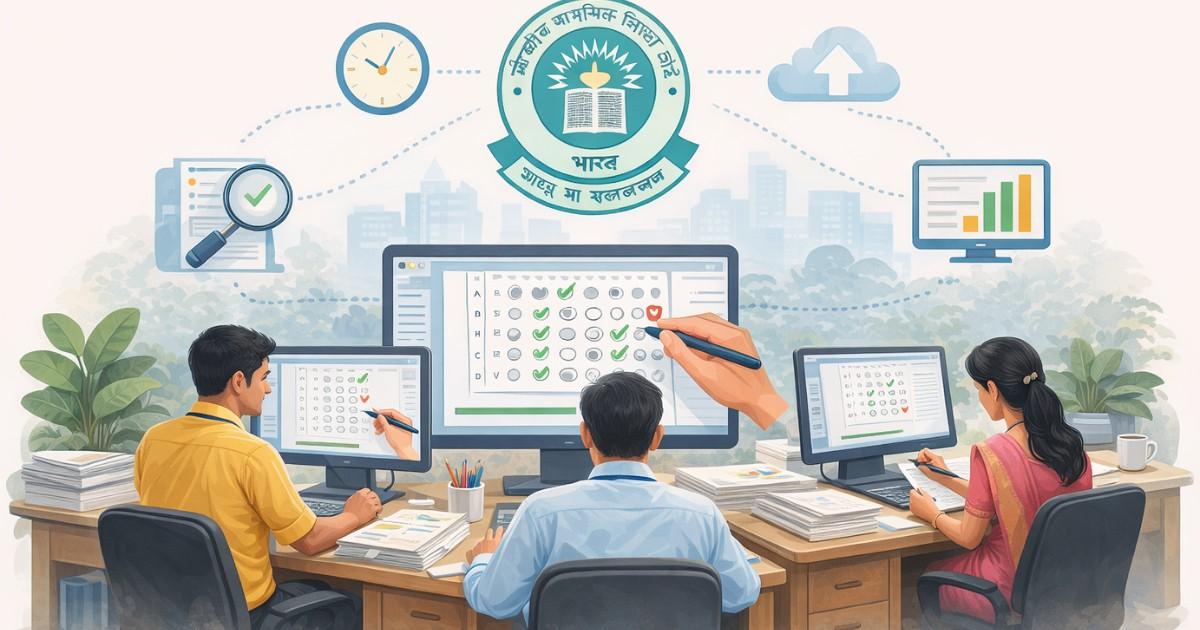
On-screen marking replaces the traditional manual checking of physical answer sheets with a fully digital process. After exams, answer books are scanned at secure centres, and evaluators assess responses on computer screens through a dedicated software platform.
According to CBSE, the system allows uniform distribution of answer scripts, real-time monitoring of evaluation progress, and built-in checks to reduce human error during marking.
Officials said digital evaluation also helps standardise the assessment process across different regions. Since all examiners follow the same on-screen guidelines, variations in marking practices are reduced, ensuring greater consistency in how answers are evaluated nationwide.
How Evaluation Is Conducted
Teachers appointed as examiners undergo training to familiarise themselves with the digital interface and marking guidelines. Each response is evaluated according to predefined marking schemes uploaded into the system.
Officials said the platform includes safeguards such as randomisation of answer scripts and moderation controls to ensure consistency. Any deviation from marking norms can be flagged and reviewed during the evaluation process.
In addition, senior examiners monitor evaluation trends to identify inconsistencies or unusual scoring patterns. This layered review process is intended to maintain uniform standards while allowing timely corrections before results are finalised.
Impact on Scoring and Results
CBSE has clarified that the on-screen marking system does not change the syllabus, question pattern, or marking scheme for Class 12 exams. Scores continue to be awarded strictly based on prescribed evaluation criteria.
Education officials noted that the digital process aims to reduce delays and improve accuracy rather than alter student outcomes. Final results are compiled only after multiple verification steps are completed.
Officials also said the system reduces the risk of missing pages, totaling errors, or manual data entry mistakes. These checks are expected to strengthen confidence in the final scores released to students.
Why CBSE Is Expanding Digital Evaluation
The board has gradually expanded on-screen marking to manage the large volume of answer sheets more efficiently. With lakhs of students appearing for Class 12 exams each year, digital evaluation helps streamline logistics and reduce the time required to declare results.
CBSE has stated that data security measures are in place to protect student information and maintain confidentiality throughout the evaluation cycle.
Officials added that digital systems also reduce physical handling of answer books, lowering logistical risks. The approach allows the board to scale evaluation capacity while maintaining tight administrative control over the process.
What Students and Teachers Should Know
CBSE officials have advised students to focus on clear presentation and adherence to answer guidelines, as evaluation standards remain unchanged. Teachers involved in marking are expected to follow the same academic judgment as in manual evaluation, supported by digital tools.
Further updates or clarifications related to the evaluation process, if any, are expected to be communicated through official CBSE notifications as the examination cycle progresses.
Education authorities said awareness among students and teachers is key to reducing anxiety around new systems. Clear communication and training are expected to ensure a smooth evaluation process during the upcoming board exam cycle.
Also read: Assam Releases Final Voter List After Special Summary Revision, Over 2.4 Lakh Names Removed
Add News Vent as a preferred source on Google – Click Here
Last Updated on: Saturday, February 14, 2026 4:13 pm by News Vent Team | Published by: News Vent Team on Saturday, February 14, 2026 4:13 pm | News Categories: Education
About The Author